From CFO to CEO: Why the keeper of the numbers is increasingly taking the top job
Dr Annurag Batra writes on how Godrej Consumer Products appointing global CFO Aasif Malbari as MD and CEO reflects a larger change in the way companies are looking at leadership
 by
by
Published: Aug 12, 2026 10:37 AM | 6 min read
 Follow Us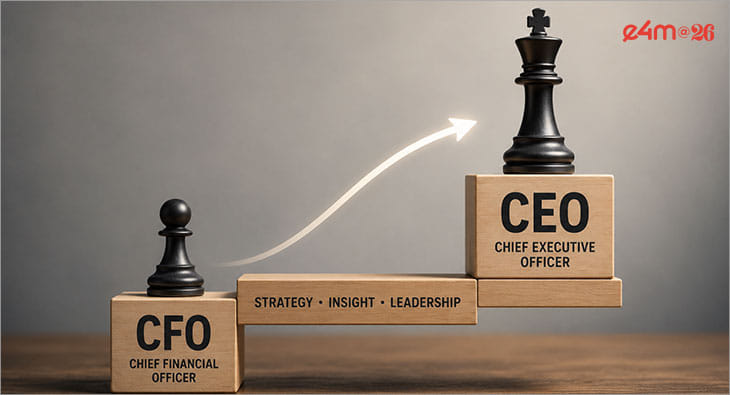

- The role of the CFO is evolving from primarily managing financial responsibilities to becoming a key decision-maker in business strategy, with companies increasingly viewing CFOs as potential CEO candidates.
- Recent appointments, such as Aasif Malbari at Godrej Consumer Products and Fernando Fernandez at Unilever, illustrate this trend, highlighting CFOs who have extensive business leadership experience beyond finance.
- Modern CFOs are expected to possess a comprehensive understanding of the entire business, including consumer behavior, market dynamics, and operational challenges, in addition to financial acumen.
- The traditional career path to the CEO role is becoming more flexible, with boards seeking leaders who can integrate strategy, execution, and financial performance, prompting a shift in the questions CFOs ask from "Can we afford it?" to "How can we make it work?"
“The modern CFO is no longer just the person who protects the balance sheet. Increasingly, he or she is becoming the person who helps decide where the business should go.”
There was a time when the roles were clearly defined. The CEO drove the business, understood the consumer, shaped the strategy and inspired the organisation. The CFO sat close to the CEO, but his primary responsibility was the numbers — costs, cash flows, margins, investments and the balance sheet. He was often the person who asked the difficult question: “Can we afford it?”
That distinction is slowly disappearing.
Around the world, companies are increasingly looking at their CFOs as potential CEOs. The latest example in India is Godrej Consumer Products, which has appointed its global CFO Aasif Malbari as Managing Director and CEO, replacing Sudhir Sitapati. The appointment is particularly interesting because Malbari has also handled business responsibilities, including as president of Godrej Africa and GCPL International.
So, this is not simply a case of a CFO moving into the CEO's chair. It reflects a larger change in the way companies are looking at leadership.
The CFO is moving closer to the CEO's chair
Godrej Consumer Products is not alone. One of the most interesting examples is Unilever, where Fernando Fernandez became CFO in January 2024 and was appointed CEO just over a year later.
At first glance, it looked like a straightforward CFO-to-CEO transition. But Fernandez's career tells a different story. He was not simply a finance professional. During his long career at Unilever, he had handled several business and geographical responsibilities, including leading its Beauty & Wellbeing business and senior roles in Latin America and Brazil.
Unilever was therefore not merely promoting its CFO because he knew the numbers. It was promoting a business leader who happened to be the CFO.
The same pattern was visible at HSBC, where Georges Elhedery moved from Group CFO to Group CEO in 2024. Before becoming CFO, he had already held significant business responsibilities, including as co-CEO of Global Banking & Markets.
These examples suggest that boards are not necessarily looking for finance specialists to become CEOs. They are looking for business leaders who have developed a strong financial perspective.
The CFO sees the whole business
The CFO occupies a unique position inside an organisation.
The marketing head understands the consumer. The sales head understands the marketplace. The operations head understands execution. The HR head understands people and culture.
The CFO, however, gets to see the financial consequences of almost every major decision taken by all of them.
The CFO knows which businesses are growing and which are not. Which brands are generating healthy returns. Where costs are rising. Which markets are consuming capital. Whether an acquisition is delivering what was promised. And whether growth is actually creating value for shareholders.
More importantly, the CFO is usually sitting next to the CEO when the biggest decisions are made — acquisitions, restructuring, capital expenditure, expansion, pricing and cost reduction.
Over time, this gives a good CFO something extremely valuable: a 360-degree view of the organisation.
The CFO may not always originate the idea, but he or she understands what that idea means for the entire business.
Growth is no longer enough
The nature of business itself is also changing.
For years, the primary conversation in a consumer company was about growth. How much did sales grow? How much market share was gained? How many new consumers were acquired?
Today, boards and investors are asking a harder question: What kind of growth are you delivering?
Growth without margins can become a problem. Market share without profitability can destroy value. Expansion without adequate returns can become an expensive exercise.
Input costs can rise suddenly. Geopolitical developments can disrupt supply chains. Currency movements can affect international businesses. Consumers can quickly change their purchasing behaviour.
In such an environment, financial discipline becomes a strategic capability.
This could be one reason why the CFO is becoming increasingly attractive as a CEO candidate.
But being a CFO is not enough
Knowing the numbers does not automatically make someone a good CEO.
A CEO has to understand people, consumers, brands, competition and culture. He or she has to make decisions when information is incomplete, take risks and persuade thousands of employees to follow a common direction.
A CFO who remains confined to finance may therefore find the transition difficult.
The CFO who has moved beyond finance is a different proposition.
That is why the careers of Fernandez and Malbari are important. Their experience has extended beyond financial management into business leadership and international operations.
The modern CFO needs to understand the P&L, but also the consumer. Cash flow, but also competition. Costs, but also culture. Shareholder returns, but also the long-term health of the business.
The CEO's closest business partner
There is another reason the CFO has an advantage.
The CFO is often one of the few executives who can challenge the CEO objectively. The marketing head may ask for more brand investment. The sales head may want greater market spending. Operations may seek additional capacity.
The CFO has to ask whether the organisation can support those decisions and whether they will ultimately create value.
That makes the CFO an important sounding board for the CEO.
Over time, this daily interaction gives the CFO a deep understanding of how the organisation works, what keeps the leadership awake at night and what needs to change.
The old career ladder is changing
There was once an unwritten career ladder to the CEO's office. In consumer companies, it often ran through sales, marketing or general management. In industrial companies, it could be operations. In technology companies, engineering or product.
That model is becoming less rigid.
The CEO can emerge from almost any function if that person demonstrates the ability to lead the entire organisation.
The rise of the CFO is therefore not about finance replacing marketing or sales. It is about the definition of leadership becoming broader.
The board is ultimately looking for one person who can bring together strategy, people, execution and financial performance. The CFO, by virtue of the role, already sits at the intersection of many of these functions.
Perhaps that is why the traditional question asked by the CFO — “Can we afford it?” — is changing.
The modern CFO is increasingly expected to ask a different question: “How can we make it work?”
And that could be the question that takes more CFOs into the CEO's chair.
The CFO may no longer be simply watching the numbers.
He or she is increasingly being asked to lead the story behind them.
Read more news about Digital Media, Television Media, Out of Home Advertising, Print Media, Latest Advertising India
For more updates, be socially connected with us onInstagram, LinkedIn, Twitter, Facebook, YouTube & Google News